Leadership today requires a different kind of endurance.
The pace is faster and the pressure is heavier. Teams are navigating constant change while leaders are being asked to make decisions with less certainty and more visibility than ever before.
Recently, The New York Times highlighted how CEOs across industries are increasingly using one word to describe what modern leadership now demands: Resilience.
At Steer, we believe resilience is a trainable leadership capability. The environment will continue to shift, markets will change, and pressure will show up unexpectedly. Strong leaders prepare for that reality by developing the internal capacity to stay clear, steady, and effective when conditions become difficult.
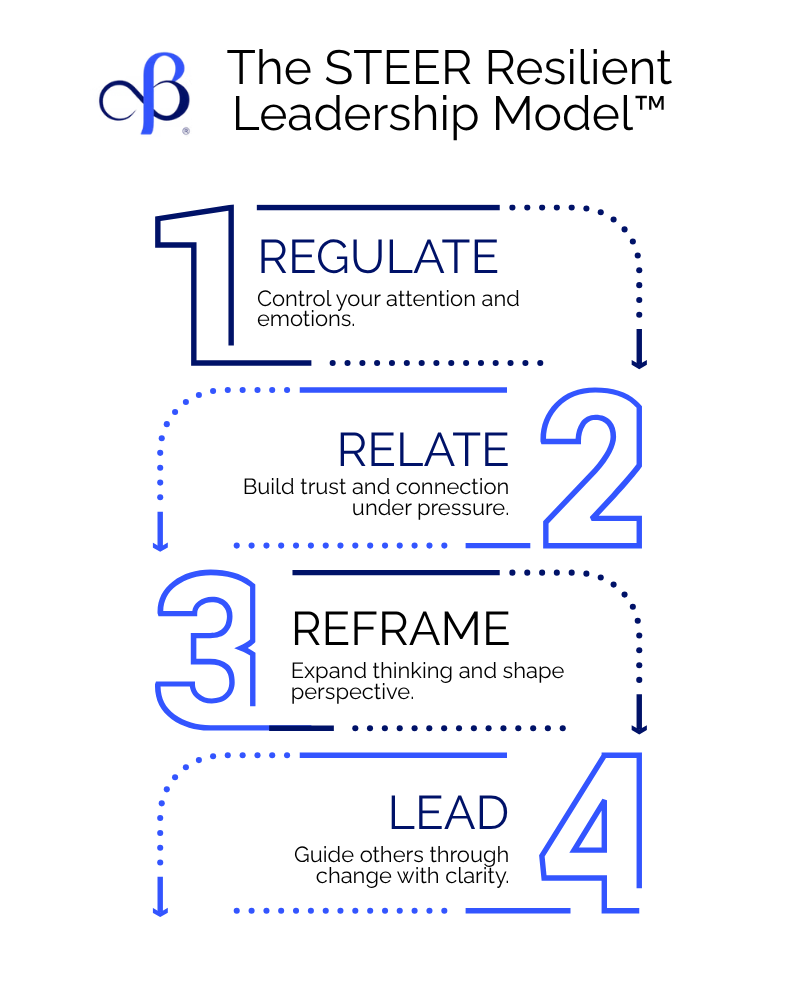
That belief became the foundation for The Steer Resilient Leadership Model™:
Elite athletes train for contact, fatigue, adversity, and recovery because performance depends on preparation long before game day arrives.
In football practice, coaches use a blocking sled, a heavy padded frame designed to absorb repeated impact. Players drive into it over and over again because everyone knows the hit is coming. Training builds the ability to stay balanced, controlled, and effective through contact.
Leadership works the same way. The leaders who sustain performance are building the mental, emotional, and relational skills required to lead effectively inside uncertainty.
Fate whispers to the warrior, ‘You cannot withstand the storm.’ The warrior whispers back, ‘I am the storm.’
Coming soon inside the STEER Lab: The Resilient Leader Course. A practical leadership experience designed to help leaders strengthen performance, regulate under pressure, build trust, and lead effectively through uncertainty. Here is a preview.
Pressure changes how leaders think and respond. The brain narrows focus, speeds up reaction, and pushes people toward automatic patterns. It is very easy to begin reacting instead of responding intentionally.
Between stimulus and response there is a space. In that space is our power to choose our response. In our response lies our growth and our freedom. - Viktor Frankl
Practice the Rep | You always have the ability to choose your response. Build awareness, embrace the pause, and choose an intentional response.
Teams absorb pace, tone, steadiness, and emotional energy from their leaders constantly. Behavioral science calls this emotional contagion. Trust grows through consistency, presence, and attention over time. In uncertain environments, people remember how leaders made them feel.
Practice the Rep | In your next conversation, slow down your need to solve. Instead, lead with: “Help me understand.” or “Tell me more.”
How leaders frame a situation shapes how teams experience it.
Resilient leaders widen the frame. They help people see clearly without minimizing reality. They create perspective, direction, and possibility inside difficult moments. The same challenge framed as chaos creates one response. Framed as a problem to solve, a lesson to learn, or an opportunity to adapt creates another.
Practice the Rep | When pressure rises, ask yourself:
- How am I framing this for my team?
- Am I creating clarity or creating fear?
- What can I control, influence, and let go?
Leadership matters most in what we call the messy middle, the stretch between disruption and stability where teams begin questioning direction, energy, and confidence.
Practice the Rep | Lead with the 4 C’s in mind:
- Care: Let people know they matter
- Clarity: Simplify, be clear and concise
- Consistency: Show up steadily over time
- Context: Help people understand the “why” behind the work
The hits are coming.
Like the blocking sled, resilience is built through reps: conversation by conversation, setback by setback, decision by decision.
Become a leader who sustains performance by training for the moment before it arrives.