Gallup released the 2026 State of the Global Workplace earlier this month and the number that should stop every senior leader cold is not the headline engagement figure. It is the manager number.
Manager engagement dropped nine points since 2022. Five points in a single year. For the first time in Gallup's history, managers lost the engagement premium they historically held over the people they lead. They are now only as engaged as their teams.
What the data tells us:
- The average manager today oversees 12.1 direct reports, up from 8.2 in 2013.
- 97% also perform individual contributor work on top of their leadership duties.
- They spend less than half their time actually managing people. The rest is absorbed by administrative load, reporting, and organizational firefighting.
- They are being squeezed from every direction without a system to sustain their performance.
The problem is the absence of a system.
Elite athletes perform under extraordinary pressure week after week, season after season. They are able to do this because they train inside a system that accounts for every phase of performance, beyond game day.
Readiness before the competition. Deliberate practice between competitions. Full effort during performance. Structured recovery after. Then the cycle repeats, each time building on the last.
Leaders are expected to perform at the same level every day, week after week, without any of this. No readiness protocols. No structured practice. No recovery built in. Just performance, indefinitely, until something breaks.
Gallup's research found that when managers receive both training and ongoing support, their well-being jumps from 28% to 50%. This is training inside a sustained system.
We built the STEER Performance Conditioning Cycle™ around this notion. Five stages that mirror exactly how elite athletes develop sustained high performance over time. Here is what each stage means in practice for leaders.
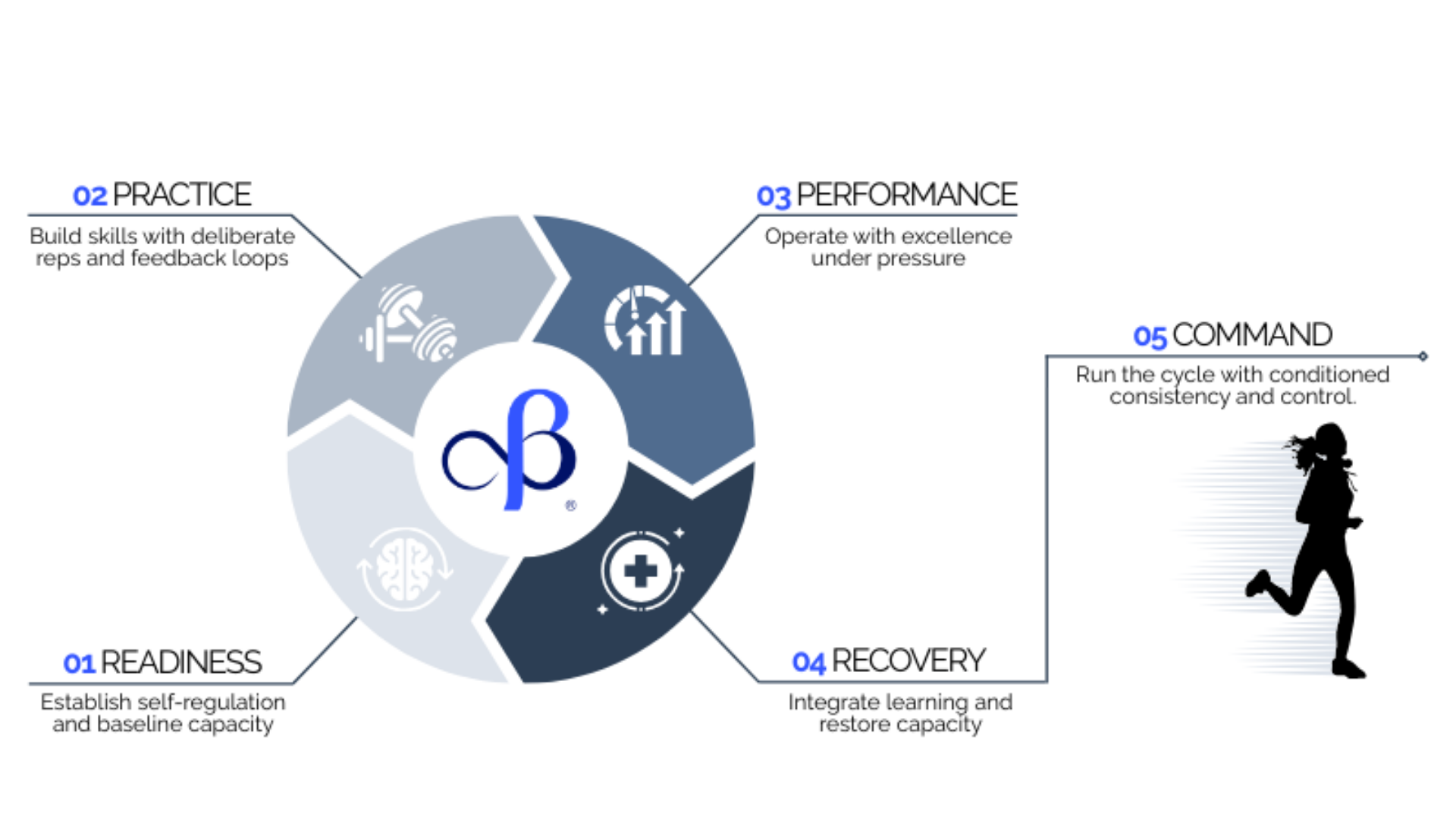
Establish self-regulation and baseline capacity
Before any elite athlete competes, they establish their baseline. They warm up. They regulate their nervous system. They assess where they are today before they ask anything of themselves.
Neuroscience research consistently shows that the prefrontal cortex, the part of the brain responsible for decision-making, judgment, and emotional regulation, is significantly compromised when leaders operate from a place of chronic stress or dysregulation. Readiness for leaders looks like this:
- How do you start your week?
- Do you know your mental and emotional state before you walk into a necessary conversation?
- Do you have a baseline for your own performance the way an athlete has a baseline for their physical condition?
Most leaders go from zero to performance with no warm-up at all. They walk straight into the arena without checking whether they are actually ready for it.
Readiness means building a simple weekly ritual before you engage. Five minutes of intentional preparation before the week starts. Want to know your baseline?
Build skills with deliberate reps and feedback loops
Anders Ericsson's research on deliberate practice, later popularized by Malcolm Gladwell, established that expertise is a function of structured, intentional practice with feedback. Elite athletes break their game down into components and work on each one deliberately, with coaching, with film review, with immediate feedback on what worked and what did not.
As a leader, do you do this?
Most leadership development asks leaders to learn a concept in a seminar and then immediately apply it in high-stakes situations with no practice in between. That is the equivalent of teaching someone a new golf swing on the driving range and then putting them in the Masters the next morning.
Practice for leaders means treating the skills of leadership the way athletes treat technique: communication, feedback, coaching conversations, difficult decisions. These are skills that can be broken down, practiced, and refined.
Practice means one thing each week. One skill you are deliberately working on. This could be having the actual conversation, making the actual decision, giving the actual feedback, and then reviewing how it went before the next attempt.
Operate with excellence under pressure
This is the stage organizations invest all their attention in and ignore everything that makes it possible.
Game day for a leader is the hard conversation, the critical decision, the moment someone on their team is struggling and needs exactly the right response. It is the presentation to the board, the feedback that could change someone's trajectory, the culture decision that sets the tone for everything that follows.
The leaders who perform in these moments are performing because the Readiness and Practice stages did their job.
Research from the NeuroLeadership Institute consistently demonstrates that high performance under pressure requires pre-established neural pathways that activate automatically when the stakes are real. You can only build them in the Practice stage so they are available when the Performance stage demands them.
Performance means showing up to high-stakes moments with your preparation done.
Integrate learning and restore capacity
Use recovery as your superpower.
Sport science established that physical adaptation happens during recovery. The stress of training creates the stimulus. Recovery is where the body adapts and grows stronger. Without adequate recovery, athletes do not improve, they break down.
The cognitive and emotional adaptation that makes leaders more capable over time happens in the reflection afterward. Gallup's research on manager burnout is essentially a recovery crisis. Managers are performing continuously without adequate recovery. The result is exactly what sport science would predict: declining performance, engagement, declining capacity. Recovery for leaders means a weekly review. At the end of each week, ask yourself:
- What did I do well this week?
- Where did I fall short?
- What did I learn?
- What do I want to do differently?
Fifteen minutes at the end of the week, consistently, is one of the highest-leverage investments a leader can make in their own development.
Run the cycle with conditioned consistency and control
Command is what happens when the first four stages become the default operating system rather than the exception.
The leaders who sustain high performance over years and decades are the ones who conditioned the cycle into their weekly rhythm so deeply that it runs automatically. They prepare before they perform. They practice the skills they want to develop. They give everything during the moments that matter. They recover and reflect so each cycle builds on the last.
Command is Permanent Beta in practice. Always improving, never done growing. Running the cycle with enough consistency and control that development compounds over time.
The data on manager disengagement is the predictable outcome of asking people to perform indefinitely without a cycle that sustains them. In my experience, the best coaches internalize the cycle so efficiently that it is invisible to everyone around them. The solution is a system.
As James Clear said:
You do not rise to the level of your goals. You fall to the level of your systems.Here are four questions to ask yourself right now:
- Did I establish my readiness before the moments that mattered this week or did I walk into them unprepared?
- What leadership skill did I deliberately practice this week, not just deploy?
- Where did I perform at my best and what made that possible?
- Did I take fifteen minutes to recover and integrate what I learned before the next week begins?
If you can answer all four, you are running the cycle. If you cannot, you now know which stage needs your attention.